
Chapter 8 Nuclear Force
8.1 The deuteron
The simplest nucleus in which we can study the nuclear force is the deuteron (1 proton and 1 neutron), since there are only two nucleons with no Coulomb repulsion.
8.1.1 Properties of the deuteron
-
Nuclear spin:
-
Parity: even
-
Magnetic dipole moment, = 0.857
-
Charge distribution, half radius = 2.1 fm (i.e. half charge within radius)
-
Binding energy, E = 2.224 MeV
-
No excited states of deuteron exist
8.1.2 Deuteron spin
The deuteron spin represents the total angular momentum of the deuteron (note it is conventional to use to represent the total angular momentum of nuclei, not ). It includes the spins of the neutron and proton and their orbital angular momentum:
| (8.1) |
where is the neutron spin (with a quantum number ), is the proton spin (with a quantum number ) and is the orbital angular momentum (with a quantum number ). Note that this is a vector equation.
For , we can have and parallel, i.e. with , 1 or 2 (Fig. 8.1). Alternatively, if and are anti-parallel, and must be 1 (Fig. 8.2). Please refer to the slides for more detailed diagrams of this.

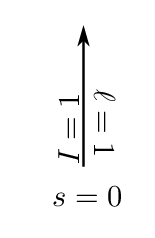
Difficult 8.1.1.
We can distinguish between these four possibilities on the basis of parity. The parity of the deuteron is inferred from its reactions to be even. It is given by:
| (8.2) |
, and are all even, this implies must be even, so the options are excluded and we conclude and must be parallel () with or . How can we distinguish between them?
The observed magnetic dipole moment of the deuteron . The expected value for =0 is
| (8.3) |
The experimental value is consistent with the deuteron spending 96% of its time in the =0 state (and 4% in the =2 state). Mixing of values in the deuteron is the best evidence we have for the non-central character of the nuclear force.
8.2 Properties of the nuclear force
The nuclear force has the following properties which should be reproduced by any theory describing it:
-
•
Strong (100 electromagnetic force)
-
•
Short-range (cuts off at 2 fm)
-
•
Attractive, with a repulsive core
-
•
Charge independent (no distinction between proton and neutron)
-
•
Saturation force (BE/nucleon is constant 8 MeV/nucleon)
8.3 The depth of the nuclear potential
8.3.1 Schrodinger’s equation for a spherically symmetric potential
The time-independent Schrodinger equation for a particle of mass in a potential is,
| (8.4) |
where is the Laplacian. In spherical polar coordinates, this is
| (8.5) | |||
For simplicity, we will assume that the deuteron is in the state (all the time, rather than just 96%). In this case, the interaction potential is spherically symmetric and thus only a function of .
We can then search for separable solutions of the form
| (8.6) |
The angular terms are the spherical harmonics (see Krane page 27 for a discussion)
| (8.7) |
The radial part is
| (8.8) |
Recall this equation is for a single particle, but the deuteron has two nucleons. The Hamiltonian of a two-body problem can be reduced to a one-body problem if one uses the reduced mass, given for the deuteron by
| (8.9) |
and is the distance between the two particles.
8.3.2 Square well model of nuclear potential

We assume the nuclear potential can be represented by a 3D square well potential of radius and depth , as illustrated in Fig. 8.3. Here represents the separation between the proton and the neutron, so is a measure of the diameter of the deuteron.
The solution to Eqn. 8.11 for is oscillatory
| (8.12) |
where
| (8.13) |
For the solution is exponential
| (8.14) |
where
| (8.15) |
Remember for a bound state, . We can argue that (r) must remain finite both as and as , so and . We can also apply continuity conditions on both and at
| (8.16) |
| (8.17) |
Dividing Eqn. (8.17) by Eqn. (8.16), we obtain
| (8.18) |
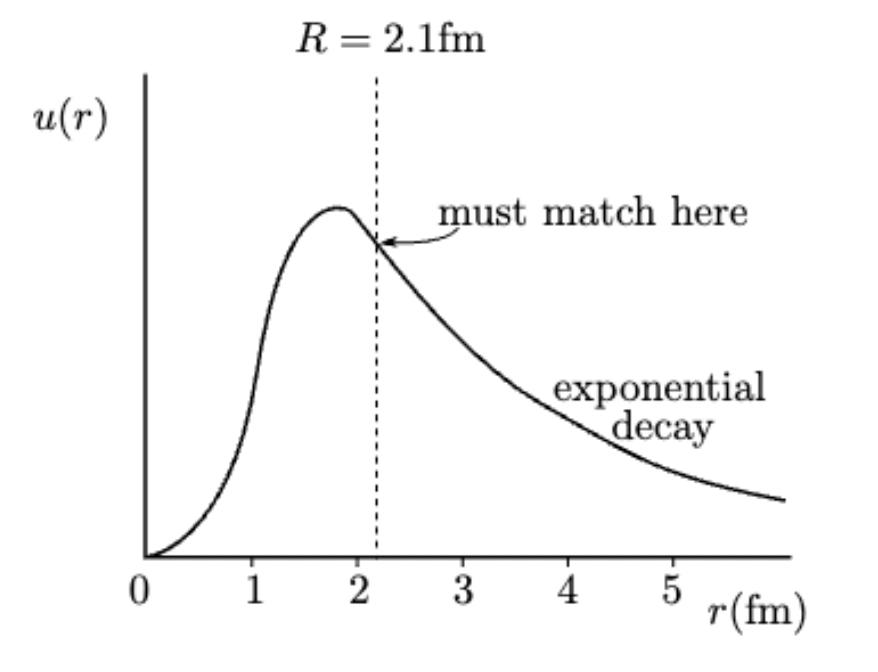
This transcendental equation gives a relation between and . From electron scattering experiments, the RMS charge radius of the deuteron is found to be fm. Solving Eqn. (8.18) numerically with fm and for MeV, we can get and then substitute in to find . We then find 35 MeV. This is the depth of the potential well holding the 2 nucleons together.
A 3D square potential can only have a bound state if it is sufficiently deep. As , the wave function must have enough curvature within the binding region to allow it to match a decreasing exponential for (see Figure 8.4.
8.3.3 Bound states of the deuteron
The bound deuteron is very close to the top of the potential well (, MeV). If the nucleon-nucleon force were just a bit weaker, the bound state would not exist. (This would have profound consequences for nuclear synthesis, big bang/star burning etc.) No bound deuteron state exists for anti-parallel spins (). Therefore the nuclear potential must be spin-dependent and appreciably weaker when the two nucleons interact with anti-parallel spins. This explains why there are no ‘di proton’ and ‘di neutron’ states. In both systems, the Pauli Exclusion Principle would require the spins to be anti-parallel and the potential is too weak to allow bound states, even for the uncharged ‘di neutron’. We can account for this by a spin-dependent term in the potential of the form .
Example 8.3.1 (Probability Example).
In this example, let’s suppose the binding energy, , of the deuteron is not given by its usual value, but instead by the condition . For and , (i) determine ; (ii) derive normalised wavefunctions for both and ; (iii) determine the probability that , i.e. the proton-neutron separation is less than the range of the strong-nuclear force.
Solution.
(i)
Assuming , we can rearrange to find
The reduced mass is
Plugging this in
(ii) To normalise we require . Since the wavefunction is only a function of radial co-ordinate then .
Since this means we require . This integral can be split into two parts,
At the boundary, we have:
Since we are assuming ,
or alternatively
Substituting back into Eqn. (Solution), we get:
The first integral is
and the second integral is
This fixes the normalisation by the condition
(iii) The probability of finding the proton-neutron separation less than is
Using the result from part (ii)
This gives
Example 8.3.2 (Bound States).
Consider the sum of two nucleon spins
| (8.19) |
Calculate the change in the nuclear potential between singlet and triplet states.
Solution.
In analogy with the spin-orbit coupling of the shell model write
| (8.20) |
Calculate the expectation value using
| (8.21) |
giving
| (8.22) |
We have . Allowed value of are (called a singlet state) and (called a triplet state). For the triplet state
| (8.23) |
For the single-state
| (8.24) |
8.4 Scattering of neutrons by protons
Let us now turn our attention away from the bound deuteron state and consider the scattering of neutrons by protons. Experimental measurements of this scattering cross-section are shown in Figure 8.5.

At low energy, the cross-section is measured to be 20.4 b, whereas simple scattering theory predicts 4.5 b. What is the reason for the discrepancy?
The total spin for the proton and neutron, , can be 0 or 1 (remember we are not considering the bound state of the deuteron here for which we argued we must have ). corresponds to a singlet state and corresponds to a triplet state.
As the incident neutron approaches the target proton, the probability of a triplet state is and a singlet state . If the scattering cross-section is different for singlet and triplet states, then
| (8.25) |
The theoretical prediction of 4.5 b was based on parameters obtained from the deuteron which is in a state. If we therefore assume b, we can use the measured value of b to deduce that b. This large difference re-affirms our assertion that the nuclear force is very spin-dependent.
Difficult 8.4.1.
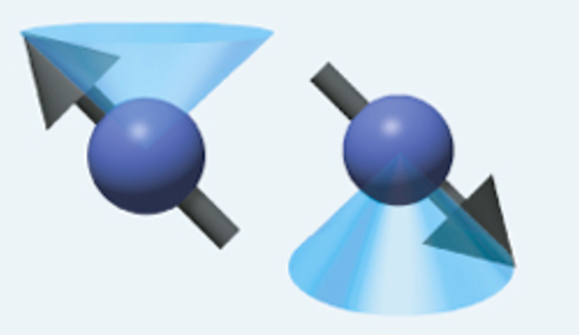
The total spin for the proton and neutron, , can be 0 or 1. The state only has 1 possible z component of spin () and is called a singlet state. You can visualize the spins of the two particles as in Fig. 8.6 (notice the spins are equal and opposite and the z component is 0).
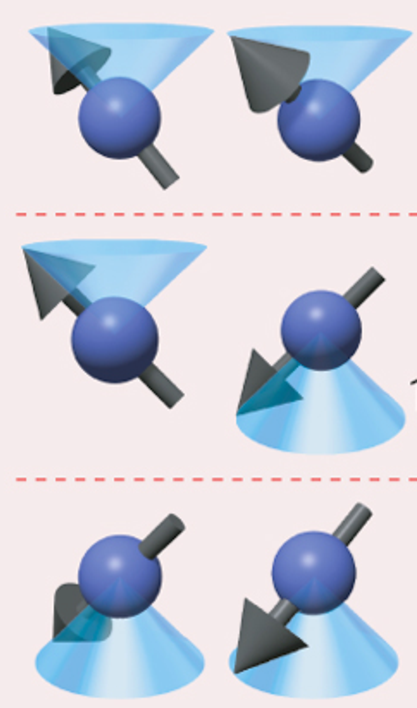
The state has 3 possible z components of spin () and is called a triplet state. You can visualize the spins of the two particles as in Fig. 8.7 (notice the spins add up to give a total spin of with different z components in each case).
8.5 The exchange model
Extensive programmes of nucleon-nucleon scattering up to the GeV range have led to very detailed representations of the nuclear potential. Each new term improves the fit to experimental data, but at the expense of simplicity and has not necessarily improved our basic understanding. What is needed is a physical mechanism that yields the empirical potentials.
This mechanism turns out to be the exchange model. During interaction, the proton and neutron can ‘exchange places’, something that is observed in many nuclear reactions. We can associate this with the exchange quanta of the nuclear force. For a spin neutron to turn into a spin proton the exchange particle must have integral spin (0 or 1 is possible). It must carry electric charge, but for n-n or p-p interactions, there must also be an uncharged variety of the exchange particle.
8.5.1 Virtual particles
Based on the observed range of the nuclear force, , we can estimate the mass, mex, of the exchange particle. The emission and re-absorption of the particle must take place within a short time, , such that we are ‘unaware’ that energy conservation has been violated. According to Heisenberg’s Uncertainty Principle:
| (8.26) | |||
If we assume that the exchange particle travels at the velocity of light, :
| (8.27) |
and the rest mass energy of the exchange particle is:
| (8.28) |
Example 8.5.1 (Virtual Particles).
Taking , we find
| (8.29) |
Such exchange particles are known as ‘virtual’ particles because they only exist within the constraints of the Uncertainty Principle.
8.5.2 Pion exchange theory
The exchange particles are identified as pions (-mesons). To satisfy all of the exchanges there must be three types, carrying -1, 0, +1 units of charge.
The pions have spin 0 and rest mass:
-
139.6 MeV/c2 ()
-
135.0 MeV/c2 ()
The pion exchange theory of the nuclear force was developed by Yukawa in 1935. It is shown diagrammatically for the different types of nucleon-nucleon interaction in Figure 8.8.
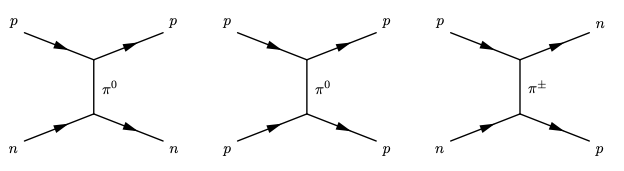
In charge exchange diagrams it is irrelevant whether we have a moving one way or moving the other way. Pion exchange can be represented by a potential of the form
| (8.30) |
Other properties of the nucleon-nucleon potential – spin dependence, tensor component etc. can be understood in various versions of this theory. However, quantitative calculations are not very successful in accounting for experimental results and the theory has been discarded in favour of quark theory. Nevertheless, investigating the properties of pions led to the discovery of many new particles and to the beginning of an understanding of the structure of nucleons.
8.6 Exercises
Example 8.6.1.
Assume the combined neutron and proton spin is and they have the same spin g-factor . The magnetic moment of the deuteron is, in terms of ,
| (8.31) |
Evaluate the expectation value of this for when the deuteron spin is , the neutron and proton spins are parallel () and (i) and (ii) .
Solution.
We need to evaluate and . This can be done by using the usual trick of writing , squaring and rearranging to obtain . Then
and similarly
The expectation values are
and
For the case we have and . This gives (setting ). For the case we have and . This gives (again setting ).